Thursday, March 27, 2008

A Clockwork Orange (1971)

I still intend to see the new Funny Games if it's not hustled out of theaters too quickly, but in the meantime I revisited the original home invasion movie (alongside Straw Dogs).

A Clockwork Orange is a 'statement' movie, but Kubrick's cinematic argument is complex and multifaceted. He presents his scenes of violence in ways that are both cinematically exciting and entertaining, as with the movie's opening fight scene with another gang, and then the film makes a sharp turn to gives us the same characters in a brutal assault on a quiet country home. This is the fine line that Kubrick is constantly walking - we're entertained and charmed by Malcolm McDowell's Alex, but we never forget that he's a dangerous sociopath motivated by nothing beyond his own narcissism, and the thought hovers in our minds through all of Alex's ups and downs. And I think this is a key to the movie's success, because Kubrick gets us to see ourselves in Alex, thrilled and horrified alternately.

Ultimately, though, Alex is only a figure in Kubrick's landscape, because his larger point has to do with how violent individuals function within a modern society, and the nature of punitive measures vs. free will. Alex receives the Ludovico treatment, which makes him nauseated in the presence of sex or violence (and Beethoven), and his prison chaplain argues that his now-'cured' actions are not motivated by free will, but merely by simple self-interest. But this treatment is merely an exagerrated version of every punitive system, from 'scared straight' programs all the way up to the promise that if you sin, you go to Hell.

On top of all that, I realized that the original Funny Games is Haneke's own version of the Ludovico treatment, a form of cinematic Pavlovian conditioning.

These days, I think that A Clockwork Orange is one of Kubrick's weaker films, a film motivated by snarky anger as opposed to his real masterpieces (for me, 2001 and Barry Lyndon), which tend to have a greater degree of compassion and spiritual reflection. In addition, it's probably the most dated of all of Kubrick's movies in terms of production and costume design, and I've never really understood the ending - that final shot of a crowd of people applauding copulation in the middle of some freakshow desert? But this is all relative, and even a 'weak' film from Kubrick is better than most filmmakers can manage in their careers.

8/10

Sunday, March 23, 2008

Hot Fuzz (2007) & Face/Off (1997)

So I was watching the new movie (from last year) from the Edgar Wright/ Simon Pegg team, and generally enjoying it. It's a fun comedy, full of Michael Bay-esque camera tricks and juicy dialogue and great performances from Pegg, Nick Frost, and a great supporting cast, from Paddy Considine as a moustached detective to Timothy Dalton as a smarmy tycoon.

My reaction to the movie is complicated. On the one hand, I'm totally jealous of Edgar Wright and his ability to absorb the directing style of a Michael Bay wanna-be and adopt it into comedy form. He's totally learned how to move the camera and edit and where to stick music to make for a successful homage to that kind of style, and as a young filmmaker myself, I'm totally envious.

At the same time, the film that Wright has made never transcends the mode of 'homage' to become its own thing. In making fun of dumb action movies, Wright never really says anything about his chosen genre in which cops take down bad guys with ruthless, cool efficiency beyond 'yeah, these movies are stupid, but they're so much fun!' which isn't exactly an original or rigorous stance. Hot Fuzz is a movie about movies which never really goes beyond its own source material, which becomes ultimately disappointing. Considering that Wright and Pegg's previous film, Shaun of the Dead, was a fully competent, entertaining zombie movie which also doubled as a critique of late-period slacker mentality, Hot Fuzz has to be seen as both a step backward in content even as it is a step forward in craft.

So after I watched the Hot Fuzz DVD, I had a hunger for some similar action movie. But as it happens, my trash genre-of-choice is horror, and I have very few shoot-em-ups in my DVD collection. So I chose to watch a movie from one of Michael Bay's antecedents, the very Christian, very intelligent John Woo. Face/Off is probably my favorite of his films, a totally wacko action movie about split identities that Fritz Lang might have made in one of his less restrained moments, decades ago. The premise is the kind of thing that only could work in a movie: the only way supercop John Travolta can learn where a bomb is hidden is by disguising himself, via high-tech surgery, as terrorist Nicolas Cage; who then proceeds to disguise himself as master cop John Travolta, leading to a complicated dance of identity within a thriller framework. The result is a messy, chaotic action movie that doesn't make total sense within real-world logic but almost completely works within movie-logic, which is all that matters. John Woo is able to render his idea that criminals and their pursuers have more in common than either want to admit, and boat chases ensue. Both Travolta and Cage overact as the bad guy while flailing as the good guy, indicating an underwritten script, but it still has an action sequence set to "Over the Rainbow" so that's something.

I love it anyway, because of Woo's capacity in handling big emotions in an otherwise absurd premise and his ability to craft satisfying action sequences. This is one of the only movies I can think of that, when it became clear that there would be a gratuitious action sequence at the end of the movie involving a boat chase, my thought in 1997 was, 'great!'. So even thought this movie doesn't say anything deep about cops and criminals, its entertainment value makes it worthwhile, as one of the better action films of the era , a thoughtful piece of pulp.

Hot Fuzz: 7/10
Face/Off: 8/10

Wednesday, March 19, 2008

The Band's Visit (2007)

Here's something we don't get enough of these days: the simple, sweet, character-based comedy. Most American movies these days are so plot-heavy that it's refreshing to see a film with just enough story to set its characters in motion, and once they're bumping into each other director Eran Kolirin can sit back and let his fine cast do the rest of the work, without needing to juice the proceedings with melodrama or contrivance.

The premise is simple: an Egyptian Police band, travelling to perform at an Arab cultural center, gets lost and finds themselves in a backwater Israeli town. There, the proud, bottled-up leader of the band (played by a terrific Sasson Gabai) asks for help from the saucy owner of a barely-open restaurant (Ronit Elkabetz). The film proceeds as a string of finely-realized emotional moments: one Egyptian is inspired by the melody of an Israeli lullaby; an girl-shy Israeli takes tips from the ladies' man of the Egyptians, and so on, with no big moments, just a soft, carefully nuanced series of moments.

What's most striking in the movie is its careful insistence on putting the Arab-Israeli conflict in the background, always present but never addressed by the film in any way beyond a basic constant tension, and one Egyptian's discreet placement of his cap over a photo of an Israeli tank. While the movie could be seen as a fairy tale of uncomplicated Mideast peace (why don't the Palestinians just exchance flatbread recipes with the Israelis and call the whole thing off?) the filmmakers succeed in balancing sentiment and realism in a satisfying, refreshing way.

8/10

Tuesday, March 18, 2008

Arthur C. Clarke, 1917-2008

This one is less of a surprise, but for me it's even more painful, because I grew up as a sci-fi nerd and Clarke was one of my trinity of favorite writers, along with Asimov and Bradbury.

Clarke's particular focus had to do with an expansive view of the universe, in which people are only a tiny part of a vast, grand cosmos, but with our own unique potential. His was an optimistic, humanistic voice that has been a huge influence on not just science-fiction but in popularizing science and making people aware of the larger world around that we all share.

But as he said last year on his 90th birthday, he mostly wanted to be known as a writer and as an entertainer, and he succeeded at that admirable: 2001, Rendezvous with Rama, Childhood's End, all terrifically entertaining and inspiring.

Also, he wasn't above wondering about ape-men and the Loch Ness monster:

Anthony Minghella, 1954-2008

This was a sudden surprise, a talented guy gone too soon. Of the films he directed I've only seen The English Patient, Cold Mountain, and my favorite of the three, the elegantly twisted identity thriller The Talented Mr. Ripley, which I love. But I also knew Minghella from his writing (Jim Henson's The Storyteller) and producing (The Interpreter and Michael Clayton). Above all, though, I knew him through his interviews on filmmaking and writing and editing where he demonstrated class, erudition, and artistic passion. His films are well-made and classy (almost to a fault) in an old-fashioned Hollywood way that's increasingly hard to find in a world of empty spectacle and pale recycling.

Condolences to his friends and family.

Abar (1977)

Or as the IMDB wants to call it, Abar, the First Black Superman, which is a much better name for a movie in which a brilliant Black scientist invents a potion that allows a young radical to develop mystical mental superpowers to avenge society's ills. Cops hassling you and planting guns on the innocent victims? Abar uses his mind powers to get the cops to decide to go home and sleep with their wives. Too many men in the ghetto sitting around on stoops drinking 40s in the middle of the day? Abar turns the bottles into clean, nutritious milk, and so on.

I like to think that movies illustrate, on a large, society-wide scale, the same psychological principles that apply to an individual, like repression, fantasy, wish-fulfillment, etc. This movie is what happens when ideas not covered in mainstream movies in the mid-1970s (rage about institutional racism in housing, discrimination, the general problems of urban African-Americans) are ignored by mainstream popular culture and only taken up by artists at the fringes who just barely know what they're doing, but do it with passionate intensity. The acting, blocking, cinematography, and sound in Abar are terrible, but the movie is intensely watchable because of its own uniqueness and the ideas and feelings it gives vent to. Not much of the movie is Abar's superpowered reign of niceness; most of its length is a sustained debate between the brilliant Dr. Kincade, who wants the freedom to live where he chooses to live with his family, in a white part of town, in spite of the immediate presence of racist whites on his front lawn with pickets and Nazi emblems; and Abar, the urban radical who urges a retrenchment in the Black community, to clean up their own problems while presenting a strong outward face to the white oppressors (and every white person in this movie is a bigoted asshole).

I'm also a fan of movies that are either so uncaring of Hollywood mainstream tradition (or so incompetent) that you never know what's going to happen next. For example, why the sequence where the movie suddenly jumps back to the 1800s where Abar is a cowboy hero saving Dr. Kincade's 40 acres and mule? The best answer is, why not? Of course, the movie's greatest narrative surprise is that it ends with a curious, almost lyrical sequence in which Abar, having transmuted malt liquor into milk, apparently makes the entire White race disappear from the face of the Earth, and proceeds to stride down the newly empty streets of Los Angeles to the most triumphant sections of Martin Luther King's "I Have a Dream" speech. Funny what squeezes out of our collective heads when nobody's looking.

6/10

Monday, March 17, 2008

10,000 B.C. (2008)

I was all set to enjoy this one, since in years past I've enjoyed Roland Emmerich'sIndependence Day and The Day After Tomorrow, but oh man, this one is no good. When your movie pales in comparison to the Godzilla remake, you've got problems.

It's almost exactly the same movie as Apocalypto - tribal warfare sets a young hero on a journey through a primitive world to a corrupt city, with pyramids, even. But whereas Mel Gibson's movie actually had a perspective and something to say through a detailed recreation of pre-Columbian life, Emmerich is only interested in the hollow CGI spectacles of wooly mammoths and slaves building pyramids.

Not that there's necessarily anything wrong with that- my enjoyment of Emmerich's earlier movies mostly stems from his ability to show us things that we've never seen before, from alien spaceships destroying American cities to vast weather formations wreaking havoc on, er, American cities. In his own adolescent, uncomplicated way, Emmerich is a visionary.

But in this movie, it feels like he's just going through the motions. The spectacle of huge pyramids being constructed by swarms of slaves and mammoth stampedes and giant flightless birds are impressive, but pointless. The narrative is just your standard self-actualization through special effects for young men, because who can prove their mettle if not by leading a multi-ethnic army of slaves against a phony god-king?

On the plus side, for a movie that's five hours long, it really flies by and only feels like 3 or 4, tops. In addition, I applaud the effort that seems to have been made to make the various 'good guys' an inclusive, multi-racial group with the hero's tribe consisting of Caucasian, African-American, Asian, and Middle Eastern actors, (including the always reliable Cliff Curtis). But the movie also falls into the same lazy trap of 300 by having the bad guys be effete 'Eastern' barbarians.

Basically, if the movie had been willing to be sillier and less earnest, with so many ponderous mid-Atlantic speeches and pointless narration, and with some more honest violence or unpretentious thrills, it could have at least been as entertaining as Lucio Fulci's Conquest or The Beastmaster. I am, however, looking forward to the sequel, 10,000 C.B., about a group of prehistoric truckers.

4/10

Tuesday, March 11, 2008

Be Kind Rewind (2008)

So I think your enjoyment of this film is going to depend on your tolerance of whimsy, and how important you think 'coherence' is vs. 'emotion' in a movie. Personally, I think Michel Gondry's newest film is terrific, an ode not just to movies in general but to what they mean to us as people, as members of a society and a larger culture.

This isn't a movie like Sky Captain and the World of Tomorrow (which I hated) or Sin City (which I liked), where the filmmakers get off on rehashing the cinematic achievements of yesteryear. Gondry is smart enough to illustrate the process of movie literacy: most of today's filmmakers start like Be Kind Rewind's Jack Black and Mos Def, literally re-creating scenes from their favorite movies verbatim, as those kids who made the shot-for-shot Raiders of the Lost Ark remake did, or as way too many people who go to film school do - when I was at USC it seemed like half of the class projects were cheap imitations of the style of 24 or Scorsese or Borat. But after a while that gets boring (for some people - for others, never) and you have to move on to telling your own stories, and Gondry dramatizes this in a lovely way, by showing a distressed, working-class neighborhood uniting under the spell of homemade art, finding both escapism and self-reflection in their own stories.

Special notice needs to go to Jack Black and Mos Def for their easy-going charm and improvisational skills, but also to the rest of the cast for simply acting like real people, not movie people, the kind who pop into a film just long enough to deliver some exposition or get saved from peril by the hero. Gondry could use a little more discipline in his screenwriting, but I'm happy to take some messiness if the result is this sweet.

One extra notice: I was mostly lost in the recreation scenes of Rush Hour 2 because I'm pretty sure I never saw it - I assume Gondry was obliged to include at least one high-grossing New Line movie, and since Peter Jackson was suing the company, the Lord of the Rings movies were out. Kind of sucks, but it's probably better that we didn't have to deal with Jack Black's impersonation of Austin Powers.

8/10

Sunday, March 09, 2008

Forrest Gump (1994) & Contact (1997)

So the way it worked was, after Roy Scheider died I rented 2010 and watched it for the first time in probably fifteen years, then I felt like watching another alien-contact movie and I had Contact in my stack of movies I haven't seen in a long time, and that was around Oscar time so I rewatched Zemeckis's Oscar-winner.

Forrest Gump is a tricky movie. It was never the full-on conservative screed that its attackers claimed it to be (the common complaint is that Forrest was rewarded for being a simpleton in the turbulent '60s, while girlfriend Jenny is punished with a lifetime of misery and death by AIDS for being politically aware), and it's not a mere feel-good heartwarmer. If the movie was summed up in one sentence, it would have to be: "The last forty years: what the f*$& was all that about?" The central irony of the movie is that while Forrest doesn't understand what's going on around him, we-the-audience do, and the effect is to decontexualize history through his perspective - John Lennon is no longer the Beatles member and Plastic Ono Band associate, but merely a nice young British man who Forrest met one day and who was murdered years later. The movie's intention is to reiterate, in fresh terms, the tragedies of the era, and what Zemeckis did was to make a movie about the contemporary American memory of the 1950s-'70s, rather than about the actual history itself. There is a flattening of history at work here, but Zemeckis doesn't distort the past any more than David Lean does in Doctor Zhivago or Robert Altman does in MASH - in each movie it's history as Macguffin, using actual events as springboards for specific artistic goals. If you lived through the specific events described, I can understand why this kind of movie might be distressing, but for someone like myself who's the child of Baby Boomers, I feel like that's missing the Forrest for the trees. (Sorry.) Just look at the last shot of Forrest Gump, the widowed Forrest sitting forlornly on a bench as his son gets on a school bus, and you see what the movie really has been all along: a lament.

Whatever you think of Forrest Gump's ideological issues, it's a very well-crafted, crowd-pleasing piece of work (granted, the movie totally jumps the shark around the 1:55 mark, when in rapid succession Forrest invents jogging, the smiley face t-shirt, and the "Shit Happens" bumper sticker) which means that when Robert Zemeckis suddenly found himself an official Oscar-Winning Director, he had to live up to it, and thus made Contact, almost certainly the most blocky, talky, stiff movie of his career.

I'm an astronomy geek, so I have a soft spot for the big load of scientific jargon that Contact lays down, its warm Carl Sagan-derived optimism, and its mostly intelligent debate between science and faith. Which is all to say that I can only forgive it for Jodie Foster's shrill, uptight performance (in twenty years she'll be the star of a Hillary Clinton biopic), the unnecessary presence of Matthew McConaughey as a hipster neo-Christian religious leader, and the tediously earnest dialogue exchanges. I still think it's a good movie because of what style Zemeckis lends it, and because it addresses issues of science and our place in the universe that few pieces of popular culture bother with, but it's also a good example of an earnest Hollywood vehicle striving for importance where a less direct approach, as in Spielberg's Close Encounters or hell, Men in Black, yields greater success.

Saturday, March 08, 2008

"Bush to veto waterboarding bill"


This is why George W. Bush is the worst President to occupy the White House in living memory. This is why his legacy needs to be swept away from the history of the United States of America. This is why Americans of all stripes should be ashamed of our elected government and be working for a new generation of leaders to bring America back into the community of nations, to rebuild our credibility with the rest of the world.

This is literally disgusting.

Tuesday, March 04, 2008

The Parallax View (1974) and Klute (1971)

An Alan J. Pakula double feature at the New Beverly, especially nice for watching master cinematographer and 'prince of darkness' Gordon Willis's widescreen compositions and moody lighting on the big screen.

I had seen The Parallax View before back in college and written a paper about it, but seeing it now confirmed one of my initial impressions: it's kind of a mess. Parallax is a fully paranoid, post-'60s thriller produced by and starring Warren Beatty as a small-time reporter who stumbles into investigating a shadowy corporation that may or may not be involved with a massive conspiracy to assassinate political leaders. In this world, the paranoia is bone-deep and the conspiracy has tendrils at every level of society, from the highest levels of government down to a local small-town sheriff. Even the politician targeted at the film's climax is a pitch-black joke, a Presidential candidate more interested in telling golf jokes and flirting with campaign aides than taking on the world's problems - he's no Bobby Kennedy, and he's barely even a George Wallace.

There's nothing wrong with the craft of the movie, Willis's cinematography, or Beatty's smart, angry performance, but the movie awkwardly tries to straddle a dry '70s naturalism with a more moody, expressionistic sense of visual dread and darkness - sort of as if Robert Altman had tried to remake a Fritz Lang film. And it could have worked, except that the screenplay has a rambling, uneven quality that never really lets us get too close to any characters or any emotions aside from dislocation. I'm a fan of conspiracy thrillers, but this one feels too much like an exercise. All that said, within the flawed package there are a number of great individual sequences, including a dazzling montage at the movie's midpoint that dissects the American dream and illustrates the spiritual malaise of America in the post-Watergate era. Given that the movie was made right at the height of that period, it's not a big surprise that the movie should give vent to the most dismal, pessimistic attitudes of the time and not have much room beyond that for characterization.

Pakula's Klute, meanwhile, is a very different animal, a more conventional romance/thriller that could have been made in the 1940s with Bogart and Bacall, except back then the movie would have been more interested in the hard-boiled detective's sense of moral outrage and honor instead of the personal emotional crisis of a high-class prostitute, which is what we get here.

Klute's set-up is classical: Jane Fonda's jaded call girl has to work with Donald Sutherland's uptight detective to solve a case. From that simple starting point Pakula takes his audience into a realm of subtle yet pervasive visual menace and modern psychological insight. Fonda's Bree Daniels is a sometime-actress and model who's managed to build a cozy little nest of denial in her secret life. Suddenly she's forced to come face-to-face with the seedy side of the world she's fallen into, and to open up to interactions with a man she can't seduce and manipulate, and who she finds herself falling for. That makes the movie sound like it has a conservative slant (detective gets hooker to wise up) but this is balanced by the movie's lack of moralizing about Bree's role as a prostitute, that she serves her clients' emotional needs more than she does their physical ones; and the movie's general sense of sympathy towards the have-nots, as highlighted in a scene where a pair of frantic heroine addicts are denied their fix by the presence of Sutherland, obviously a cop, in their apartment. A lesser movie would have smirked at these junkies, but Pakula chooses to simply watch and silently commiserate with the couple in their moment of woe. Add in Fonda's Oscar-winning work and Sutherland's understated yet strong supporting role as John Klute, plus a world-class creep performance from the movie's bad guy, and you have a modern classic, which I'm glad to have finally seen.

Sunday, March 02, 2008

Charlie Bartlett (2008)

Just because this movie is going to be a staple on Comedy Central in a couple of years is no reason to punish it unduly, or ignore that it's generally charming and likeable.

Just like Max Fischer from Rushmore, Charlie Bartlett is an intelligent, ambitious young man with little in the way of conventional social skills, but with a deep need for love and acceptance. In fact, Max and Charlie have so much in common, that screenwriter Gustin Nash begins Charlie Bartlett with a fantasy sequence of peer approval which the lead character is abruptly woken up from, just like the opening of Rushmore. From that point on, there are plenty of parallels, but director Jon Poll doesn't have Wes Anderson's unique visual sensibility and the movie typically makes safe, conventional teen-movie decisions. When you're borrowing the same back-of-the-car sex scene from The Girl Next Door, you can't be given too much credit for originality.

But let's move on from that and give Charlie Bartlett credit for what it does have, which is a sharp cast and a reasonably engrossing story that, even if it's not breaking any new ground, at least holds your attention for an hour and a half as Charlie uses his intelligence and empathy (and financial resources) to help his fellow students with their hidden problems and anxieties and in the process learns that popularity isn't the most important thing. Special credit should to go newcomers Anton Yelchin, Kat Dennings, and Tyler Hilton as Charlie, his teen love interest, and the school-bully-with-a-heart-of-gold, respectively. Faint praise? So be it, but charm shouldn't be underrated, even in our post-Juno world.

Saturday, March 01, 2008

Celebrity Sighting of the Day

Lindsay Lohan, if you can count not really seeing somebody as a 'sighting'. I understand she was in the same Hollywood bar as I was at the same time, but since she wasn't accompanied by her usual halo of paparazzi flashbulbs I didn't actually notice her.

Anybody else up to anything?

Wednesday, February 27, 2008

Leprechaun: Back in tha Hood in Mobile, Alabama

This is fascinating to me. We're all familiar with the puff-piece news stories that take up an increasinly large amount of the nightly newscasts in between Lou Dobbs anti-immigrant rants, but apparently we've finally gotten to the point where ordinary people are casting themselves as the accomplices in these kind of good-natured wastes of time. I mean, I can understand why a person would think that they're really seeing the Virgin Mary in a tortilla, but a leprechaun in a tree in a black neighborhood in the deep South? I guess it's a kind of self-fulfilling media feedback loop: be a part of some crazy story, get on TV, watch yourself on TV being crazy, but it's all in good fun.

My favorite is the woman sitting in her car.

Miller's Crossing (1990)/ No Country for Old Men (2007)

I wanted to see No Country again after its Oscar win, but first I decided to revisit the early Coen film that had the least impact on me, Miller's Crossing.

Set amidst of the gang wars of Prohibition, Miller's Crossing is, for me at least, probably the Coens' most impenetrable movie, but that may simply be the result of Gabriel Byrne's Irish brogue combined with the defiantly un-hip '20s slang that every character recites (They could have called this Yeggs: The Movie). And watching the Oscars reminds me that the Coens, like so many of their characters, have severely low-affect personalities, from the laconic H.I. McDunnough of Raising Arizona to the stubborn Llewelyn Moss. It's great when it works, but for me, Byrne's Tom Reagan just isn't interesting or conflicted enough as a character to carry me through the movie, and his arc seems to be muddled. In the film's plot, which is borrowed heavily from Dashiell Hammett's Red Harvest, Reagan functions as the go-between, the guy who plays both sides against each other, and if his arc is to show him becoming disillusioned by his own actions within the world he lives in, it's not clear to me why a career gangster would be so affected by the specific events of this movie, to turn away from his father figure (Albert Finney) and the woman he may or may not love (Marcia Gay Harden) by the end of the film. It's a handsome movie and well-shot and performed, but it doesn't resonate with me as much as Raising Arizona or Fargo.

On the other hand, the places where Miller's Crossing falls short serve to highlight where No Country for Old Men excels. Where Miller's is stifled by its own production design and old-movie homages (the same factors that basically killed The Ladykillers), No Country is fresh, existing in a fully-realized 'real' world; for the first time in a long time, the Coens are interested in their characters as real people and not as movie archetypes.

The exception to this rule is Anton Chigurh, who's been described as an allegorical 'grim reaper' in plenty of reviews, but the truth is that he's just a mirror image of Tommy Lee Jones' Ed Tom Bell (literalized in two scenes), with Josh Brolin's Llewelyn Moss an in-between version of both men, a silent man of the country corrupted by the intrusion of a crapload of money into believing that he can outwit 'the ultimate badass', and the progress of the movie is the temptation and fall of Moss. It's not that Moss fails in his face-off against Chigurh, it's that he never had a chance in Chigurh's world. At the end of the movie, it's Carla Jean's moral victory that she chooses not to play Chigurh's coin-toss game. For the bulk of the movie, it's Moss's failure that he keeps playing over and over again, like an addicted gambler. Of course, the twist of the movie's ending is that even though Chigurh has beaten all of his human adversaries, the house still holds the ultimate trump card - Chigurh can outsmart a Texas welder, but he can't beat the random whims of the universe.

I recognize that this is somewhat rambling - I'll pick it up again soon.

Monday, February 25, 2008

Oscar recap

So what surprises there were were generally positive. All four acting winners were my personaly favorites, and while it was obvious that Day-Lewis and Bardem would win, I was very happy for Cotillard and Swinton, since I didn't think they had a real chance. Obviously I'm also happy that the Academy rewarded No Country for Old Men, a challenging and thoughtful thriller and probably the best Best Picture winner since Schindler's List, and the Coens, and even though my personal favorite for the top awards was Paul Thomas Anderson, his time will come in the decades to come.

Otherwise, hey Coens? You need to fill up on Affect, you both seem to be a couple quarts low. And who knew that Scott Rudin was gay? (Okay, a lot of people but not me.) I knew he loved to scream at and fire his assistants and underlings, but this has got to be the first time a Best Picture winner has thanked his same-sex partner, right?

On the downside, even though Robert Elswit did great work in There Will Be Blood, I would have preferred for Roger Deakins to win for Cinematography, and some small part of me was still hoping that Brook Busey-Hunt (aka Diablo Cody, I hate pseudonyms) wouldn't win Best Original Screenplay. And there were too many lame filler pieces, like the remembrance 'When I won my Oscar...' things and the stupid 'Inside Price Waterhouse' thing, that felt like they had been shot before the strike ended and included because hey, we already shot and edited them, so let's use them to pad the show out!

I ended up going 14/24 on my predictions, which is typical for me. I had no idea The Golden Compass would win for Best Visual Effects and or Elizabeth: The Golden Age would win for Costume Design, among others.

Sunday, February 24, 2008

My 2008 Oscar Picks

It was a pretty good year not just for movies in general but for the Oscars: this year, there isn't a single movie nominated for Best Picture that I think is out-and-out bad, as with Crash in 2006 or The Hours in 2003. Even the weakest movie nominated this year, Juno, is pretty good, probably better than Little Miss Sunshine and definitely better than Ray or Seabiscuit. So anyway, here's my list of what I think will win and what I think should win:

Best Short Film, Animated/Live-Action:
I don't know, I don't really care. None of them could be as shitty as last year's Live-Action winner, West Bank Story. I think Madame Tutli-Putli is a good title so I'll root for it, and I hear The Mozart of Pickpockets is good so let's go with that.

Best Documentary, Feature/Short:
I regret to say that I haven't seen most of these either. I understand that No End in Sight is probably the best-made feature and while I liked Sicko, it was pretty flawed, so I have no dog in this race. Let's say No End in Sight and Freeheld.

Best Foreign Film:
Since such films as Persepolis, The Orphanage, 4 Months, 3 Weeks and 2 Days and more didn't make the cut, it means that I haven't seen any of the films nominated, which means: pick the film that involves Nazis, so here's to you, The Counterfeiters.

Best Animated Feature:
Ratatouille is by far the best of these. Persepolis could pull off an anti-Pixar upset, but why would Hollywood choose to pick on the only company that reliably produces films that are both profitable and high-quality?

Best Visual Effects:
Michael Bay designed and edited the robots in Transformers in such a way that you could never really get a good look at them, and since the Academy already awarded the effects team from Pirates 2, I figure they'll do it again for Pirates of the Caribbean: At World's End.

Best Sound Editing/Mixing:
These could possible become part of a No Country for Old Men sweep, but I'm actually going to pull for the loud insanity of Transformers for one reason: sound mixer Kevin O'Connell is on his 20th nomination and the man's streak has to end sometime.

Best Original Song:
Oscar voters love their winners to have stories behind them, which is why I figure they'll pick "Falling Slowly" from Once.

Best Original Score:
I'd prefer for Michael Giacchino to win for Ratatouille after not even being nominated for The Incredibles, but Dario Marianelli will probably win for Atonement and that'll be just fine.

Best Makeup:
La Vie En Rose wins by being neither primarily digital (Pirates 3) nor part of a noxious movie (Norbit).

Best Editing:
The Academy tradition would be to include this as part of the Best Picture coattails, but I don't see the Academy giving an award to the fictional Roderick Jaynes, so instead Christopher Rouse will win for The Bourne Ultimatum, the film with the most editing.

Best Costume Design:
I'm going to say the Academy-traditional Atonement and that green dress, although it could just as easily be Sweeney Todd.

Best Art Direction:
This tends to go to lush period sets, so I don't see why they wouldn't give Dante Ferretti his second Oscar, for Sweeney Todd.

Best Cinematography:
Elswit won the ASC award, but I'm going to say that Oscar coattails outweigh vote-splitting and give Roger Deakins his much-deserved first Oscar for No Country for Old Men. He should get it for Jesse James instead, but who cares.

Best Original Screenplay:
I predict to be pissed off when Diablo Cody goes up to win her trophy for a movie that was rescued from its own screenplay by its director and cast. I'd love to see an upset from Tony Gilroy but my real favorite is Ratatouille.

Best Adapted Screenplay:
I have a feeling that this is where Paul Thomas Anderson gets his recognition, which is fine with me. If the Coens win, we know for sure what wins Best Picture.

Best Supporting Actor:
There's an outside chance for a Hal Holbrook upset, but it's almost certainly going to be Javier Bardem, as well it should.

Best Supporting Actress:
The year's most wide-open category, my preference is for Tilda Swinton but I have a feeling it'll go to awful mom Amy Ryan. Blanchett won just a few years ago, Ronan is too young, and Ruby Dee's role just isn't big enough.

Best Actor:
How can it not be Daniel Day-Lewis? In your face, David Poland's predictions from over a year ago.


Best Actress:
I'd love for Marion Cotillard to win, but it's very rare for a foreign-language performance to win here. Julie Christie is the likely winner, especially because she's an Academy veteran and her movie hits home with their voters, but I won't be shocked if Ellen Page upsets here.

Best Director:
Les Freres Coen.
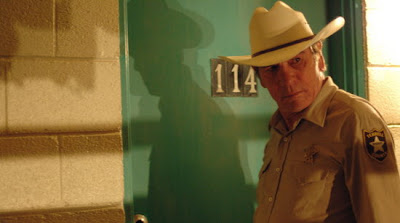
Best Picture:
No Country for Old Men. While I have an idiosyncratic preference for the insular epic There Will Be Blood in this category and director, I won't be sorry at all if the Coens' lament in the form of a thriller takes the top price. I can imagine possible upsets from the popular Juno or the more Academy-friendly Atonement, but this seems to be the Coens' year.

Friday, February 22, 2008

The Spiderwick Chronicles (2008)

First of all, when I saw this Wednesday night at the Arclight, they didn't attach the Indiana Jones trailer to it - WTF? (Of course, I've downloaded it a few times already - it's sloppy but I'm excited.)

Childrens' movies are funny things. We tend to overvalue the movies that we grew up with and look down on those of a later generation, which of course isn't fair, but what can you do? The movies we saw as kids are, for most people, the way we learned to watch movies in the first place, our original encounters with chills and thrills, and it's hard to detach oneself from such primal experiences.

Anyway, as specifically regards The Spiderwick Chronicles, I gave it a shot because the trailers made it look like something potentially special: a kid's world expanded by the revelation that there's a secret world just outside the reach of the everyday, accessible to those in the know (in other words, I wanted to see if it would be this generation's The Neverending Story). The film involves Jared Grace (Freddie Highmore, from Finding Neverland and Charlie and the Chocolate Factory), who moves with his family to a big creaky old house in the aftermath of his parents' divorce, and quickly escapes into a world of ogres and fairies and whatnot.

The primary problem with the movie is that even though it's loaded with spectacle in the form of the various CGI trolls and griffins, it's a little short in the wonder department, as the screenplay is so rushed and full of action that little time is left over for the discovery of the unseen world, for the development of suspense and uncanniness - the CGI drowns out the basic, more subtle emotions. The secondary problem is that the underlying subtext of the movie - that the fantasy world allows troubled Jared Grace to learn to cope with his parents' divorce, a la Elliot's situation in E.T. The movie obligingly gives Jared a cathartic substitution (SPOILERS) by having the movie's Big Bad guy turn into Jared's philandering father for one scene, just long enough for Jared to stab him in the chest (!), after which he goes back to being a CGI troll. Direct, yet clumsy filmmaking, and it lacks a proper emotional throughline or perspective.

So even though the movie is an entertaining ride, it's a mixed bag because the filmmakers have chosen to prioritize CGI action over simple storytelling and emotional meaning. It's the same thing that tainted last year's otherwise-excellent Bridge to Terabithia and threatens to tilt each year's Harry Potter movie into nonsense, except for Alfonso Cuaron's episode.

A few other points: I do give the movie credit for being really scary and intense in places, as a good kids' movie should be. Freddie Highmore actually plays twin brothers in this movie, doubled by digital mattes, which is distracting - I can see why they did it, but it still means that the poor actor's performances are frequently disjointed. Also the music is by serial self-plagiarist James Horner, who this time rips off his score for A Beautiful Mind.

Tuesday, February 19, 2008

4 Months, 3 Weeks and 2 Days (2007)

Ah, Armond White. Sometimes he's brilliant, sometimes he's a parody of himself. White displays his ridiculous side once again with his negative review of this terrific, deeply humanist new film which won last year's Cannes Palme d'Or. If the Romanian New Wave movies like this and The Death of Mr. Lazarescu weren't getting such praise from his colleagues in New York, he'd probably be praising them for their formal control, literary qualities, and insistence on moral and political questions, but since he's been beaten to the punch and remains compulsively contrarian, he has to twist himself in knots to declaim them as 'bullcrap'.

Set in Ceausescu's Romania, 1987, 4 Months, 3 Weeks and 2 Days has been labelled an 'abortion movie' but, as with Mike Leigh's Vera Drake, abortion is only the movie's macguffin: the real subject of this movie is to watch how a person copes with living in a repressive society in which bribery, ID checks, and lies are pervasive. Director Cristian Mungiu uses his supporting characters to show us the different ways a person can choose to function in an inherently corrupt system (SPOILERS): one can retreat into childish helplessness, as the pregnant Gabita does; one can become an opportunistic predator, as the abortionist does; one can blithely ignore society's problems, as the guests at the dinner party do; or one can turn into an anonymous functionary, just doing one's job, as with the movie's various hotel workers and cops. Forced to navigate through these options is the movie's protagonist, Otilia, a well-meaning young woman who exists in a world in which there can be no good outcome, just a string of bleak options, and the film is the story of her harsh coming-of-age.

What makes the movie rise above its own grimness are the authenticity of the performances and direction, and the tension and momentum of the story. When Otilia finds herself trapped in the above-mentioned dinner party and a phone rings, it's as suspenseful as anything in a Hitchcock movie. Later, when Otilia wanders through the nighttime streets on a grim mission, the film becomes chaotic, pitch-black, as existentially scary and nightmarish as 28 Weeks Later or Inland Empire.

It's a terrific, unflinching achievement and Armond White does himself no favors by choosing to be obtuse, as he does here.

(PS: Added 4am) I would have to say that the film is pro-choice, if I had to label it as such, because its primary interest is to show the awfulness involved when otherwise decent people are forced to circumvent the law. Somehow Armond White, in what I can only reconcile as an example of his being so perversely liberal he becomes ultra-conservative, deems the women in this movie 'biologically irresponsible' - who's the real post-feminist? It's one of his more maddening pieces of writing in a long time.

Monday, February 18, 2008

Song of the South (1946)

It's strange to revisit a movie that you last saw 20+ years ago, especially when it's been completely out of circulation, and to find that it still hits an emotional nerve. This is, of course, the classic Disney movie that has never appeared on home video in the U.S. and has been pulled from public viewing for years out of fear of its depictions of African-American stereotypes, which I saw unexpectedly tonight at a special screening.

In some happier part of the South located not far from Gone With the Wind's Tara, young Johnny travels with his parents to his Grandmother's plantation, when suddenly his father has to turn back around and leave them for reasons the movie glosses over (Business? Killing Yankees?). Distressed, Johnny makes new friends and listens to the colorful stories of Br'er Rabbit told by local 'magical negro' Uncle Remus.

As it happens, Uncle Remus is no more racist than the various 'magical negroes' in The Legend of Bagger Vance or The Green Mile, and he's substantially less racist than Jar-Jar Binks or various characters in 300. Remus is a sympathetic figure and a positive stereotype - but a stereotype nonetheless, and the movie is suffused with the notion that its cheerful African-American characters (whose labor status on the plantation is fuzzy, to say the least) are there to defer to the white, upper-class Southern family at its center and help young Johnny work through his individual growing pains and traumas. Disney movies and kids' movies tend to traffic in stereotypes and simplistic, easy-to-follow iconography, which makes it possible for me to forgive this film for its depictions but also to agree with Roger Ebert that it doesn't really need to be released for general viewing. There's no reason to make American kids feel any more entitled than they already are.

All that said, it's remarkable how well the movie holds up in spite of its problems, and it's strange to realize that the whole movie is an allegory of Disney's own brand of filmmaking, casting himself as Uncle Remus, whimsical storyteller clashing with the sensible, disapproving mothers of America, which suggests a certain self-pity within Disney's mind - Uncle Walt never lived in a wooden shack. But the central idea - that Uncle Remus's stories allow young Johnny a way to get through his growing pains - was surely designed for an audience whose fathers were just coming back from Europe and the Pacific, and it resonates today in a time when kids are left to their own devices as much as ever (albeit more in suburban realms than gauzy rural ones). It's a surprisingly charming, if naive and flawed, piece of work.

(Hopefully before Black History Month is over I can also write an "It's not that bad!" review of either The Jazz Singer or The Birth of a Nation. That's a joke.)

Saturday, February 16, 2008

What's Up, Tiger Lily? (1966)/ Cassandra's Dream (2007)

Woody Allen's directorial debut (sort of) and his most recent film, neither of which are completely satisfying. I was a big fan of Woody back as a kid and in high school, where discovering his style and comic persona for the first time in movies like Love and Death and Radio Days were revelatory, even without getting the Bergman references (I also got the lead in our high school production of Play It Again, Sam - my one major theatrical experience). It's been a long time since those days, though.

What's Up Tiger Lily? was the first film Woody Allen directed, a Japanese spy movie re-edited with concert footage of the Lovin' Spoonful and overdubbed with new, comedic dialogue about the hunt for a secret egg salad recipe. It's cute and sporadically funny (it helps that the spy movie is pretty campy on its own) and it sort of works as an attempt to extend Allen's comic persona into a feature-film, loaded with Jewish references, lousy puns, and sexual innuendo. Today it all seems fairly dated and half-baked (most episodes of Mystery Science Theater 3000 are both funnier and more wide-rangingly deconstructive), and the original Japanese movie is kind of sluggish in spite of being truncated.

Cassandra's Dream is Match Point all over again with the pieces rearranged. This time Ewan McGregor is the detached, ambitious social climber instead of Jonathan Rhys Meyers, and instead of an absurdly bitchy Scarlett Johansson we have a mopey Colin Farrell as the hesitant, remorseful brother who's In The Way. Match Point was at least entertaining and slick even if it didn't live up to its own pretentiousness, but this one is predictable and boring, with incredibly stiff, stagy performances that suggest that Woody limited his direction to 'stand here' and 'say this'.

I give credit to Allen for insisting on investigating the same moral question over and over again (how do people justify committing immoral deeds to themselves?) but he's got to think of something interesting to say on the subject that he didn't already say twenty years ago in Crimes and Misdemeanors, in half the running time (to wit: they just do). Special notice goes to Haley Atwell, as McGregor's ambitious, blithely horrible girlfriend. She's either a very good actress or a truly awful person playing herself.

Friday, February 15, 2008

In Bruges (2008)

The marketing for this one makes it look like a throwback to that '90s staple, the wacky gangster comedy, but this film has a lot more on its mind than simple imitation of the blood-and-banter formula launched by Reservoir Dogs and Pulp Fiction - or rather, what's more accurate to say is that In Bruges follows more strictly in the footsteps of those movies than most of their spawn, because like Tarantino's first films, In Bruges wraps a layer of sardonic comedy around a serious moral core.

A pair of hitmen, impulsive and inexperienced Ray (Colin Farrell) and steady, reflective Ken (Brendan Gleeson) find themselves sent to Bruges, Belgium by their boss Harry (Ralph Fiennes) after a hit gone wrong. Once there, it's a clash between Ray's frustration and buried guilt over the hit, Ken's appreciation of the history and culture of the city, and the crassness of the tourists and assorted drug dealers and prostitutes they run into. Writer and director Martin McDonagh displays not only his skill for dialogue but a talent for crafting striking visuals and blending moods and tones. Like Tarantino's film, McDonagh isn't afraid to mix politically incorrect humor (making fun of fat people and dwarfs) with serious drama and a convincing romance between Ray and Chloe (Clemence Poesy). The film is only marred by some predictable plot twists and contrivances, but on the whole it's a thoughtful, moody piece of work that I found very entertaining.

It's also nice to see Colin Farrell doing the kind of movie he should be doing - something offbeat, smaller, playing a slightly scuzzy but essentially nice guy - and hopefully it's a sign he's getting away from the clutches of the studio system that's tried to force him into doing roles he wasn't well-suited for and seemed to flail in, like Alexander or Miami Vice. Gleeson and Fiennes, meanwhile, tear into their rich parts like the great character actors that they are.

Thursday, February 14, 2008

Tuesday, February 12, 2008

The Diving Bell and the Butterfly (2007)

It's a good movie, but I've been holding off in reviewing it until I could decide whether it was a truly great movie or if what felt like flaws in my first viewing would linger in my head. And like I said, I like this movie - I like it a lot - but it's not perfect.

Julian Schnabel's film is the story of Jean-Dominique Bauby, struck down by a cataclysmic stroke in the prime of his life. Bauby was diagnosed with 'Locked-In Syndrome', finding himself completely paralyzed except for his left eye and eyelid, only able to communicate by blinking. The story unfolds from Bauby's perspective as he tries to cope with what's happened to him, coupled with flashbacks of his family and love life and fantasy sequences.

Julian Schnabel clearly identifies with Bauby as a successful bon vivant with big appetites for life and women, working in a glamourous industry (Bauby was editor of French Elle magazine; Schnabel was a world-famous artist before he moved into filmmaking) and as such, there's an unavoidable sentimentalization of Bauby's pre-stroke life. Schnabel makes it clear that Bauby wasn't a saint, that he had difficulties staying faithful in relationships and shirked his duties as a father, but Schnabel never really takes him to task for these personal flaws, apparently deciding that the stroke was punishment enough. It's not a major flaw in the movie but my personal preference would have been for Schnabel to not soften his character and his flaws quite so much. As a comparison, Jim Sheridan's My Left Foot offers a character in a similar situation who's still honestly presented as a dick. This aspect of the movie conforms to the standard Hollywood movie template regarding the handicapped, where a crippling injury or disease becomes inherently ennobling.

What marks the difference between My Left Foot and Diving Bell is directorial inventiveness and first-person immersion into Bauby's situation. Cinematographer Janusz Kaminski is essentially a co-director of this film, putting the audience directly into Bauby's head for the first act of the film. It's a dazzling, disorienting experience - we watch through his eye, but are unable to move or interact with the world we see, just as Bauby was. Ultimately it's this tactic that makes the film succeed - it doesn't matter who Bauby was before his stroke. When watching the movie, he's us, and we're him, and the journey that proceeds from that point is invigorating.

I need to make sure that I emphasize that Kaminski's cinematography is outstanding, some of the best of his career, and that the performances, especially those of Mathieu Amalric and Max Von Sydow, are excellent. it's a beautiful movie, with several heartbreaking scenes (a late one in which Bauby's wife tells him she can't stand to visit him in the hospital is especially painful). It's a beautiful movie, just not a perfect one.

Sunday, February 10, 2008

Roy Scheider, 1932-2008

A guy like Roy Scheider is the kind of underrated talent that never really gets their due in Hollywood, even as they hold movies together through the simple power of their charm and dependability. Everyone remembers Robert Shaw's salty seadog in Jaws and his Indianapolis monologue, but it's Scheider who grounds the movie and brings the audience in, a trickier job than it looks.

In addition to Scheider's classic performance as Brody in Jaws and his solid supporting roles in films from The French Connection to Naked Lunch, he got to shine as Bob Fosse, er, 'Joe Gideon' in Fosse's All That Jazz, one of the great charismatic jerks of the 1970s.

Scheider had a long, sturdy career and he'll be missed as an underrated contributor to several classic films.

Friday, February 08, 2008

The Orphanage (2007)

So at this point we have to recognize that foreigners are the only ones actually making scary movies these days - Spain, Mexico, Korea, Japan, even the French are making good horror movies right now while in this country everything's either a sensationalized mishmash of gore and CGI or a remake of something foreign. So until we get our act together here, it's refreshing to see a new horror movie that succeeds by simply presenting a solid story with good characters, a strong emotional subtext, and moody, precisely-executed scares.

Laura (Belen Rueda) returns to the sprawling mansion she lived in years earlier as an orphan herself; once there, her son Simon proceeds to exercise his overactive imagination by interacting with some new imaginary friends...or are they? (Three guesses and the first two don't count). From there what I expected (based on the marketing) to be a fairly tame ghost story in the vein of The Others proceeds in creepy, unexpected, and ambitious directions.

What I especially liked about this movie are the scenes in which director Juan Antonio Bayona proves that he's going to be a strong new voice in horror movies by showing a confident hand in his orchestration of suspense and shocks. (SPOILERS) I loved the scene in which the old lady is hit by a truck and maimed; it's become a cliche to have a character suddenly bulldozed by a car, but Bayona manages to make it surprising, then compounds the brilliant awfulness of the scene by showing, in a painfully protracted close-up, the old lady's destroyed face - but only after teasing us with a tiny glimpse to make us think that the visual is going to be left to our imagination. The result is something filled with a huge amount of dread and guilt, and it's masterfully choreographed. Another, later scene, in which a psychic (a terrific Geraldine Chaplin) goes into a trance and attempts to communicate with the ghosts haunting the estate is a terrific mix of performance, sound design, and suggestion.

It's interesting to note (SPOILER AGAIN) that just as in Pan's Labyrinth, this movie resolves a heartbreaking, horrific situation by allowing its lead character to die and end up in a better place. Is this a theme peculiar to filmmakers with Catholic backgrounds? In all the Japanese ghost stories that I've seen lately, every ghost in the afterlife is pretty cranky and not fun to be around(Ringu, Ju-On, etc.).

Thursday, February 07, 2008

Funny Games (1997)

Okay, I've now seen Cache and this, Michael Haneke's original Austrian version with the American remake coming out soon. I'll give him one more movie to prove that he's not completely heartless and smug, and then I'm done with him. Spoilers follow.

The plot of Funny Games is straight-forward. A middle-class family (including the late Ulrich Muhe, from The Lives of Others) is going for a weekend trip to their lake house, which is disrupted by two violent, psychopathic home invaders, a pair of charming young men. Torture and suspense ensues.

Now I'm firmly on record as being a fan of horror movies and movies that feature torture and violence and gore, when used the right way. And indeed, when Funny Games is operating as a suspense thriller, it's very effective: excellent performances from the leads, finely observed details, unfliching direction and camerawork. The third act of the film (out of four) is particularly strong, showing (SPOILERS) the husband and wife recovering after their son has been murdered and the killers have fled, trying to figure out what to do next, how to survive when the killers might come back. It works because the audience is allowed to firmly feel sympathy and compassion for these heartbreaking characters.

The problem is, Haneke repeatedly uses poor-man's Brechtian techniques - a character who self-consciously winks to the camera and talks to the audience, a gimmick that at one point allows the film to be 'rewound' to redo a crucial plot twist - for the purposes of drawing the viewer's attention to the cinematic artifice. Once again, I don't have a problem with cinematic self-reflexivity - when used the right way (see DePalma, Brian). Haneke's intention appears to be to indict the audience (that most tedious of film-school concepts) into analyzing their attraction to violence, and to refresh our sense of outrage, to prevent us from enjoying the spectacle in traditional ways.

That's not how the film actually works, though, if you ask me. By breaking the cinematic illusion, Haneke's effect is not to undermine our relationship with the violent spectacle of the film, but rather to undermine and mock our emotional connection with the characters and their victimhood. When Haneke shows a killer torturing a wife by forcing her to choose whether she or her husband will be murdered by shooting or stabbing, and then looks at the camera to ask, "What do you think?" The effect is to spit in the face of anyone who would have a normal, human reaction to a another's dehumanization.

Let me put it this way: if you kick me in the balls, and then say "just kidding!", you still kicked me in the balls.

It's as if Haneke is trying to undermine the entire narrative tradition, not just in film but in any medium, in which characters are developed, go through emotional rises and falls, and through their journey the author conveys meaning to the audience. The only meaning I get out of Haneke's smug manipulations are that audiences are fools for processing and enjoying conventional narratives, and while I'm all in favor of shaking up the audience, or confronting people with unpleasant stories to shake them up, I can't get behind Haneke's nihilistic, anti-cinematic agenda. As far as I'm concerned, the best way to make horrifying images impactful to an audience that's grown numb by Hollywood violence is to play it straight and honest, in films from the original Texas Chainsaw Massacre to United 93. I don't need these post-modern head games to teach me how to feel when I go to the movies.

Anyone else? The guy keeps getting called a genius, so somebody must like his stuff.

PS: At least I also know that, if the remake is shot-for-shot faithful to the original, that at some point I can see Naomi Watts draping the world's worst sweater over a transparent bra.

Wednesday, February 06, 2008

Political tidbits

I would have voted for John Edwards in the California Primary yesterday if he hadn't dropped out. Instead, I decided to vote for Obama based on the unfortunate negativity emanating from the Clinton campaign (it's kind of a turn-off) and because I've been very impressed by the huge number of new and crossover voters that Obama is luring to the polls. It seems pretty obvious to me at this point that, even though I think both candidates will be able to beat McCain in November, Obama may have an easier time if he can attract independents and even Republicans who would never vote for Hillary.

Also, the state of each campaign can be seen in two campaign-finance stories out today: Hillary and Bill Clinton have loaned $5 million to her campaign, while Obama has, just since the polls closed, raised $5.6 million. That certainly bodes well for him.

In other news, the right-wingers are trying hard to paint Rambo as something other than a mildly amusing, mildly condescending bloodfest. According to this Reuters story, those opposed to the military junta that rules Burma/Myanmar are using Stallone's movie as a rallying point.

Let's make this clear: it's great that a movie, any movie, is making America and the world in general aware of the repressive political situation in Burma. That said, the movie can't honestly claim to be anything more than crude propaganda. Stallone could have made his movie anywhere without much significant difference in what happens on-screen: just replace the cardboard Burmese bad guys with cardboard bad guys from Sudan or North Korea or Uzbekistan, stick in some white people for him to rescue (because he can't help repressed Asians or Africans on their own, that would be nonsense!) and let the revenge machine that is John Rambo do his thing.

I have to say that I'm relieved that Stallone didn't follow the 300 template here and pitch his movie as a battle between the Civilized World and the decadent forces of the East. But what he did do, suggesting that the repressed people of Burma need a white liberator, is patronizing in your standard colonialist/nothing new kind of way. So let's give Stallone credit for having heard of Burma and that's about it.

Tuesday, February 05, 2008

Last Year at Marienbad (1961)

The new print of this that's currently playing at the Nuart is a must-see for anyone in Los Angeles who might enjoy this French classic, because seeing these images and hearing that creepy organ music on the big screen is an overwhelming experience.

The plot on paper is simple: At a high-class resort hotel, a man repeatedly tries to convince a woman that a year earlier, she had agreed to run away from her husband with him. That's what you'd write on the back of the DVD, but the movie itself takes that plot and twists it into your basic New Wave mindbender freak-out, a puzzle movie with an oppressive mood of destabilization and uncertainty. It's terrific.

I tried to write a conventional review of this movie, but all I was coming up with were cliches, because I couldn't really express what this movie is about, but then I realized that what this movie is about is not knowing, and that the pleasure of the film is indulging in a heightened mood of confusion, finding yourself enmeshed in a system that seems tantalizingly close to comprehension but always just beyond your grasp, like the match game played repeatedly, or the loops of dialogue or imagery that repeat in an almost musical structure.

Pauline Kael hated this movie, as she tended to hate all the major works of heavy modernism of the 1960s, the films of Antonioni, 2001, and so on, because she had a problem with the lumbering white-elephant qualities of the time. What she missed about Marienbad is that it's a very playful movie, mercurial in its twists and turns even as it maintains a mood of being trapped in a wax museum - in its own way, this movie is the greatest Twilight Zone episode ever made.

Today few filmmakers make films about Big Questions like the meaning of life or questions of epistemology, how we remember events and 'know' anything, as Resnais does here. It's an amazing film that I highly recommend.

Monday, February 04, 2008

Ghidorah: The Three-Headed Monster (1964) and Q: The Winged Serpent (1982)

Two giant monster movies that are better than Cloverfield. Ghidorah: The Three-Headed Monster was the fifth movie in the original Godzilla series, and might just be the best after the original. To compare it to another long-running series, Ghidorah is this franchise's Goldfinger - a well-crafted distillation of everything that made the series fun, without lapsing into self-parody or tedium. And Ghidorah has it all; not only does this episode introduce King Ghidorah himself as the biggest, baddest monster on the block, it gives us a mega-melee between him (them?), Godzilla, Rodan, and Mothra with plenty of destruction.

On top of that, this movie features a fun B-plot involving a band of assassins on the trail of a missing Princess from a random Asian country who develops amnesia and psychic abilities (!) with some typically pop-'60s style.

The best scene in this movie has Mothra attempting to convince Godzilla and Rodan to team up to fight Ghidorah, at which point one of the humans watching in the distance asks, 'What are they saying?' and another responds, 'I don't know, I don't speak Monster' very matter-of-factly.

Q: The Winged Serpent comes from a very different realm, one of the last gasps of the grindhouse cinema era of the '70s from director Larry Cohen. As such, it's a movie that finely balances the rough grittiness of Ed Koch-era New York with the total absurdity of having a giant Aztec god-lizard kill people and nest in the spire of the Chrysler Building. It's goofy fun, but it wouldn't work without the anchors provided by David Carradine and Richard Roundtree (as the hard-bitten cops) and Michael Moriarty as the recovering junkie and small-time crook who just sort of randomly stumbles onto the monster's nest. He's great as a full-bodied character, sympathetic and complex, in the kind of movie that usually just shows girls taking their tops off and getting eaten. Of course, because Larry Cohen knows where his bread is buttered, he includes that too.So why are these movies better than Cloverfield? The short answer is, Cloverfield isn't fun. It has fun things in it (the girl who explodes after being bitten by a giant spider is a nice touch) but despite its cheesy, fun genre origins, the makers of Cloverfield constantly refuse to let me enjoy it, by ham-handedly forcing me to think about 9/11 and by taking its characters so very seriously and so on. Simple things.

Saturday, February 02, 2008

Rambo (2008)

You know how fat kids always wear t-shirts at swimming pools to hide their bloated corpses? Picture that as a 90-minute action movie and you've got the new Rambo.

I'm not going to exert myself by getting all pissed off over a Stallone movie, I mean, talk about shooting fish in a barrel. Even though it's a sloppy, incredibly violent cartoon with a lightly racist white man's burden subtext - that's kind of what you expect, right? So let's take all that as a given and move on.

The big reason why I can't get behind this movie as a simple, mindless piece of entertainment - I mean, I like ridiculous, cartoonish violence as much as anybody, that's why I thought Kill Bill was one of the best movies of 2003 - is that there's a disconnect between the absurdity of seeing puffy, 60-year-old Stallone rip a man's throat out with his bare hands, and the pretense of seriousness that the movie adopts from its opening montage of Burmese repression and war crimes. If the movie only knew that it's a dopey cartoon I could enjoy it; since it seems to really, seriously think that it's taking a brave stance on the political situation in Burma (Myanmar, whatever) and not realize that it's just using said situation as a pretext for exploitation, it's hard not to be annoyed.

A few other odds and ends - having never seen the previous Rambo movies of the '80s, were they always infested with Christianity as a plot motivator? This time Rambo has to rescue a bunch of relief workers but it appears Stallone didn't think it was enough that they were treating the injured and the sick, they have to be missionaries too. And likewise, isn't the evil Burmese general evil enough without being tagged as gay in one scene?