Showing posts with label Steven Spielberg. Show all posts

Friday, May 23, 2008

Indiana Jones and the Kingdom of the Crystal Skull (2008)

A proper review will be up soon, but I wanted to provide the illusion of actually spending time on it first. Also I'll add that I like the movie just fine, although I'll admit it's kind of pointless, one more go-round lacking the insane kineticism of Temple of Doom or the personal emotional core of Last Crusade. But it's a well-crafted, fun romp with plenty of Spielbergisms.

(Updated, ramblingly, 5/24/08 1:18 a.m)
I think one of the key features of this film is that the Steven Spielberg who made it is a subtly different filmmaker than the guy who made the original three films in the 1980s. It's my belief that there's a pre-Schindler's List Spielberg, who made movies characterized by clean narrative storytelling, and a post-SL Spielberg, more formally inventive, more interesting in complicated and even perverse stories, less interested in giving his audience a purely entertaining movie experience - and this is the Spielberg people don't like when they complain about the bookend scenes of Saving Private Ryan, or the endings of Minority Report or Munich, or pretty much all of A.I. Spielberg's always tried to straddle the line between mass-market blockbusters and personal art, and he's gotten more self-conscious and direct in his artistic endeavors over the last couple of decades.

So, as that relates to Kingdom of the Crystal Skull, the experience of it is substantially different from the experience of the older Indiana Jones movie - there's a distance, which makes me thing that Spielberg is kind of bored with the enterprise, doing 'one for them' to trade off against his Lincoln film and whatever else he does in the near future; and/or, that he's just not interested in giving his audience a smooth, pleasing experience, and the contrast between the older films and this one is thus more glaring. (In the same way, I think that Jurassic Park is a substantially less inventive, dynamic movie than The Lost World, but it offers a cleaner narrative and fewer narrative and thematic puzzles, and consequently JP is called one of Spielberg's minor masterpieces and TLW one of his flubs, but if you ask me, they're roughly equal in quality). At the same time, I don't think there's any way that this movie could have possibly seen as anything other than disappointing - we're talking about the fanboys, who basically just want to rehash the same experiences over and over again, and when something isn't the-same-but-a-little-different, they complain.

So once again, back to this new movie: I need to see it again to decide how I feel about it, but the range is limited: either it's a minor piece of work along the lines of The Lost World, a sequel made for trade-off purposes and thus essentially work-for-hire, yet containing some striking visuals, a terrific John Williams score, and the best Harrison Ford performance in at least a decade; or, there's a personal, subversive message embedded within it that I haven't cracked yet. If this latter is the case, the key is probably to be found in the movie's two most striking shots, which I realized today are mirror images of each other: the spectacular image of the mushroom cloud that Indy ponders, having miraculously just escaped; and the climactic image of the alien spaceship lifting off, disappearing into some other dimension, and leaving a wake of damage in its behalf. A contemplation of 20th-century scientific hubristic devastation?

More to write when I see the film a second time.

7/10

Sunday, May 18, 2008

The Indiana Jones Trilogy (1981-1989)

I'm pretty sure that I've seen Raiders of the Lost Ark more times than any other movie. My grandmother had HBO back in the 1980s when nobody else in my family did and it seemed like Raiders was always on when we'd go over to visit (along with Poltergeist and Cannonball Run II). And as a result, it's one of those movies that is utterly impossible for me to look at objectively - it's part of the bedrock of my internal cinematic landscape. And it's a perfect movie for a kid to watch, because you don't need to be able to follow things like characterization or theme, you just watch the amazingly well-made action sequences and zone out (except for when the bad guys' heads melt, that was freaky for a little kid - in a good way).

Raiders is also probably one of the most shallow great movies ever made - and I don't mean that as a slam, but merely as a description. It's an insanely well-shot and -edited adventure movie that doesn't have a lot to say except that Nazis are bad, you can be a wise-cracking rogue and still want to put artifacts in museums instead of cashing in on them, and that the God of the Old Testament is still lurking around, waiting to unleash some wrath (although apparently His being locked away in a government warehouse kept Him from stopping the Holocaust, whoops). Yeah, the joke involving the no-consequences shooting of the Arab swordsman is a little questionable in the light of the Iranian hostage crisis, but none of that matters when you're five years old. Raiders is beautiful, compulsively watchable, uniquely American (Indy just wants to do the right thing and bust some bad guy heads) and features what might be the best female performance in any Spielberg movie from Karen Allen. Also, can anyone tell me how Indy is supposed to ride the submarine for hundreds of miles to the Nazi base?

Indiana Jones and the Temple of Doom is a very uneven movie. The stunts and action scenes are even more mind-blowing than those of Raiders while being marred by an over-reliance on special effects, some of which look like they were never quite finished. The screenplay (from future Howard the Duck auteurs Willard Kuyck and Gloria Katz) is clunkier, the humor is frequently miserably lame, and then there's Kate Capshaw, and I can't think of any Spielberg movie with a moment as shoddy as the dubbed-in screams over shots of crocodiles, somewhere, chewing on leftover costume shreds - it's kind of a mess. Temple of Doom is, however, one of the first instances of Spielberg's more self-conscious side, opening with the lavish "Anything Goes" number in Cantonese on a stage impossibly large to fit within a Shanghai nightclub, the same cinematic side that would years later lead to the subtle self-referentiality and subtexts of A.I. and Minority Report. Anyway, Temple of Doom is guilty of many of the same flaws of 1941 (shrillness, obnoxious humor), but redeemed by Spielberg's raw ability to keep us entertained and Harrison Ford's presence to keep it all grounded.

Indiana Jones and the Last Crusade is the least flashy of the three movies, being in a lot of ways a return to safe Raiders territory after the dark fantasies of Temple of Doom, and yet it's also the most richly emotional of the three movies, thanks to perfect interaction between Harrison Ford and Sean Connery (this is the movie Connery should have won his Oscar for, not The Untouchables) and Spielberg's efforts to make a movie that would be more than just a thrill ride. Last Crusade also reaffirms the notion at the end of Raiders, that when faced with our deepest desires, we often need to be willing to do without, to efface what we've told ourselves are our deepest desires. On top of that, the three movies together give us the lesson, 'all major religions are valid', which is an only-in-Hollywood statement to make, that in Tinseltown dream factories, the Gods of the Jews, Hindus, and Christians have equal opportunity to kick bad-guy ass in the third act.

Besides Lucas and Spielberg, a huge amount of credit has to go to John Williams's amazing scores and Michael Kahn's Oscar-winning editing. Watching Harrison Ford in these movies is also interesting, because of how completely he underplays nearly every scene in all three movies, basically mumbling and grimacing in the face of all the beatings and torture that he endures. It's hard to imagine Tom Selleck being willing to so blend into the costume and era as Ford does.

Raiders: 9/10
Temple of Doom: 8/10
Last Crusade: 8/10

Tuesday, July 10, 2007

"Spielberg on Spielberg"


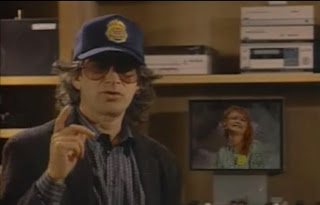
I saw this new TCM documentary last night. Apparently Richard Schickel has decided to make a cottage industry out of breezy interview-documentaries about every major American filmmaker, which he can then sell as DVD bonus features.

Anyway, it's an entertaining enough little documentary, but it stays very surface-level and never peers into the depths of Spielberg's work or his complexities as an artist. This is primarily because the movie is literally Spielberg telling his own story, and so he's free to rehash all his old stories and spin some new ones, from the comfort of his own perspective. Present are his stories about his youth and inexperience in the late 1960s, the agonies of making Jaws, the failure of 1941, his uncertainty over The Color Purple, and the controversy of Munich. I was happy to see Spielberg defend the present-day bookend scenes of Saving Private Ryan (essential for grounding the film in the present) and the brilliant ending of A.I. (part of Kubrick's original bitterly ironic treatment, not tacked on out of misguided sentimentality by Spielberg).

Not present are other stories, like his upbringing and background as a geeky suburban child of divorce; his Jaws-related Oscar embarrassment, and the strife with Verna Fields over her contributions to the film's success; his role as producer and the problems that plagued Twilight Zone: The Movie and Poltergeist; the problems of racism and violence in Temple of Doom; the failures of Always and Hook; and any significant mention of Last Crusade, Amistad, The Lost World, Catch Me If You Can, or The Terminal. When politics are mentioned, as in regard to Spielberg's critiques of governmental surveillance in Minority Report or bureaucracy in The Terminal, or our responses to terrorism in War of the Worlds or Munich, Schickel and Spielberg discreetly downplay the controversies as if to deny that any of those films contained anything that could even be considered controversial or problematic.

What I'd love to see is an objective documentary about the man (who I consider to be one of the three or four greatest living filmmakers, by the way) that goes into all the ups and downs of Spielberg's career, including a true critique of his artistic achievements and failures, including a look at his discomfort with portraying adult romance and sex, his influence on modern blockbusters, and so on. As one of the most compelling, successful, and influential filmmakers of our time, his work demands more than a puff-piece retrospective.